

Your Tax Preparer Is Right: The Residential Solar Credit Is Gone. However…
The homeowner credit is gone. The business credit is not. With a prepaid agreement, it comes off your price on day one. The trade: an investor owns the system for five or six years, then it is yours.

We are not tax experts and do not claim to be.
This post is written for homeowners in PG&E territory. Every program, price and rule below is what we see for PG&E customers.
Your tax preparer is right. The federal tax credit homeowners used to claim for buying solar ended on December 31, 2025. If you buy a system yourself today, there is nothing to claim on your tax return.
However, that is not the end of the story. A second federal credit, the one for businesses that own solar systems, is still here, and it has made something new possible. You can pay once, up front, at a discount, and own your system after just five or six years. Nothing more is expected to be due at that point.
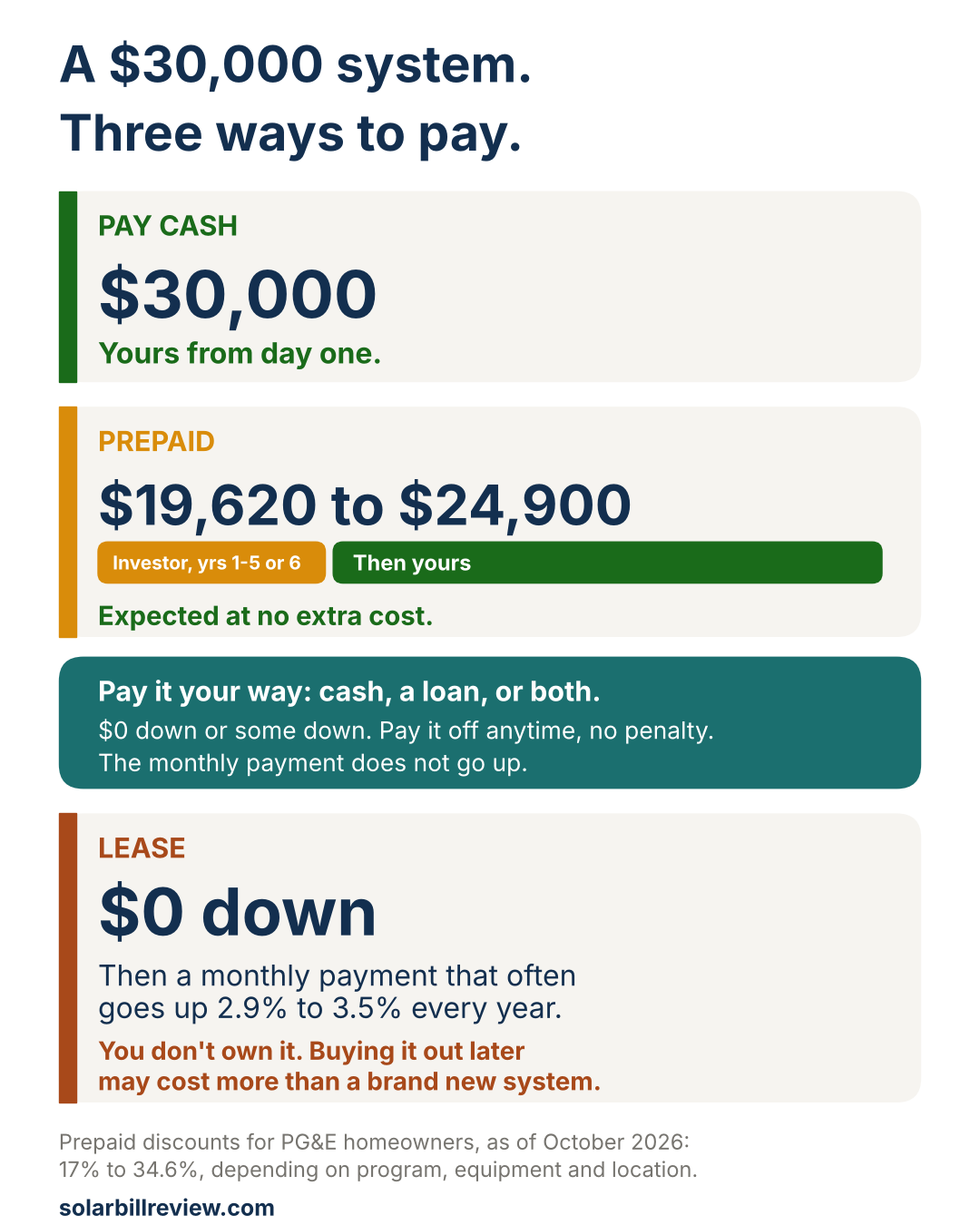
On a $30,000 system, that can mean paying as little as $19,620 up front, with nothing to file and nothing to wait for.
Short on time? Here's the 30-second version.
What is the investor tax credit?
You may hear it called the investor tax credit, the business tax credit, or by its tax code name, Section 48E. They all mean the same thing: a federal tax credit worth 30% of a solar system's cost, sometimes more, that goes to whoever owns the system. The homeowner version ended after 2025. The business version did not.
So with a prepaid agreement, an investor owns your system on paper. They claim the credit on their taxes, and you get part of its value as a lower price.
What's the catch? The investor is not doing you a favor, and that is a good thing. A tax credit is worth the most to someone who owes a lot of tax, and businesses do. They keep part of the credit's value and pass the rest to you as a discount. Your side of the trade is the wait: they own the system on paper for five or six years before it becomes yours.
What changed, and what did not
Through 2025:
- You paid full price.
- You waited until tax time to file.
- The credit only came back if you owed enough federal tax. Many people had to spread it over several years.
- From the day you paid to the day money came back could be six months to more than a year.
2026 and on:
- An investor owns the system on paper and claims the business credit.
- The discount comes off your price up front.
- Nothing to file. Nothing to wait for.
- It works the same whether you owe the IRS a lot or nothing at all.
Think of it as an investment, not a monthly bill
Most people ask, "How much will I save this month?" The better question is, "How much will I keep over the next 25 years?"
Many homeowners heard "the solar tax credit is gone" and stopped looking. But like a good stock, you did not miss your chance just because others got in earlier. What makes solar pay is PG&E's prices. Here is one Tri-Valley home using the same 400 kWh a month, priced on PG&E's own rate sheets:
- January 2014: $54.55 a month
- May 2019: $94.31 a month
- Today: $161.72 a month
That total includes PG&E's $24.15 monthly base charge, which did not exist in 2014. Every customer pays it, solar or not. You can check every number on our How Solar Affects Your Bill page.
The honest flip side: most systems today include a battery, so the investment may be bigger than it was 10 years ago. So is the bill it goes up against.
In our worst-case example further down, a home that stays with PG&E alone is expected to pay about $219,000 over 25 years. The same home with a prepaid system in an energy community is expected to pay about $63,000, all in. That is about $156,000 kept instead of spent.
Three ways to pay
-
Pay cash. You own it all from day one. Simple and clean. There is no federal credit, since the homeowner credit is the one that ended.
-
Rent the power, with a lease. Little or nothing up front. You pay every month for the power the panels make, and that payment usually goes up every year. The panels belong to the leasing company, not you. And if you sell your home, most realtors I talk to prefer a system the homeowner owns. Leases made sense for a lot of families, mine included. When I got into this business, my very first customer was me, and I signed a lease. Back then, there was no way to prepay and own.
-
Prepay and own it. You pay once, up front, at the discounted price, battery included if you have one. An investor owns the system on paper for the first five or six years. After that, it is expected to become yours, with nothing more due. Whether it is five or six depends on your equipment and where you live.
Why the wait? Federal rules say whoever claims this credit has to hold the equipment for five full years, or the IRS can take part of the credit back. The wait is not a sales trick. It is the price of the discount.

Who this helps that the old credit left out
The old homeowner credit only lowered taxes you owed. Retirees living on Social Security, with a small tax bill or none at all, often got little or nothing from it. Homes you rent out did not qualify for it at all. If your tax bill was smaller than the credit, the rest rolled over to the next year, and with little or no tax bill, you might never use it all.
A prepaid discount does not depend on your tax return. Some programs only require that you own the home, not that you live in it. If a tax preparer once told you solar would not help you, the answer may be different now.
How big is the discount?
For PG&E homeowners, as of October 2026, the discounts we are seeing run from about 17% to 34.6% off the price.
Three things move the number: which program you use, what equipment goes on your roof, and where your home is. Some neighborhoods are on a federal list called energy communities. Homes on that list get a bigger discount, about 10 percentage points more. We can check your address in seconds.
For comparison, the old homeowner credit was 30%, and you had to wait until tax time to get it.
The clock is running
The business credit has its own deadline. For projects that start construction after July 4, 2026, the system has to be in service by the end of 2027. After that, this discount is not expected to be available. Meeting the deadline is the system owner's job, but starting sooner means depending on it less.
The discounts in this post are what we are seeing as of October 2026. They can change at any time, and we expect them to shrink in 2027. As more homeowners learn about these programs, demand goes up, and when demand goes up, discounts usually come down. As far as we know, nothing requires these companies to keep their discounts where they are today.
Two programs, two deeper looks
Maxwell Power. The only one of the two that offers panels only, with no battery required. You can also add a battery. Pay once in cash, or use a loan if you prefer. Ownership after year six. Full post coming soon.
Propel by Concert Finance. Solar with a battery only, and only with Enphase equipment. Starts as a loan you can pay off right away. Ownership after year five. Full post coming soon.
Want to show this to your tax preparer?
Please do. The short version for them: the homeowner credit (Section 25D, Form 5695) ended for systems placed in service after 2025. The discount here comes from the business credit (Section 48E, Form 3468), claimed by the system owner. The homeowner claims nothing. The links are in our sources list at the bottom of this page.
Where your money goes over 25 years
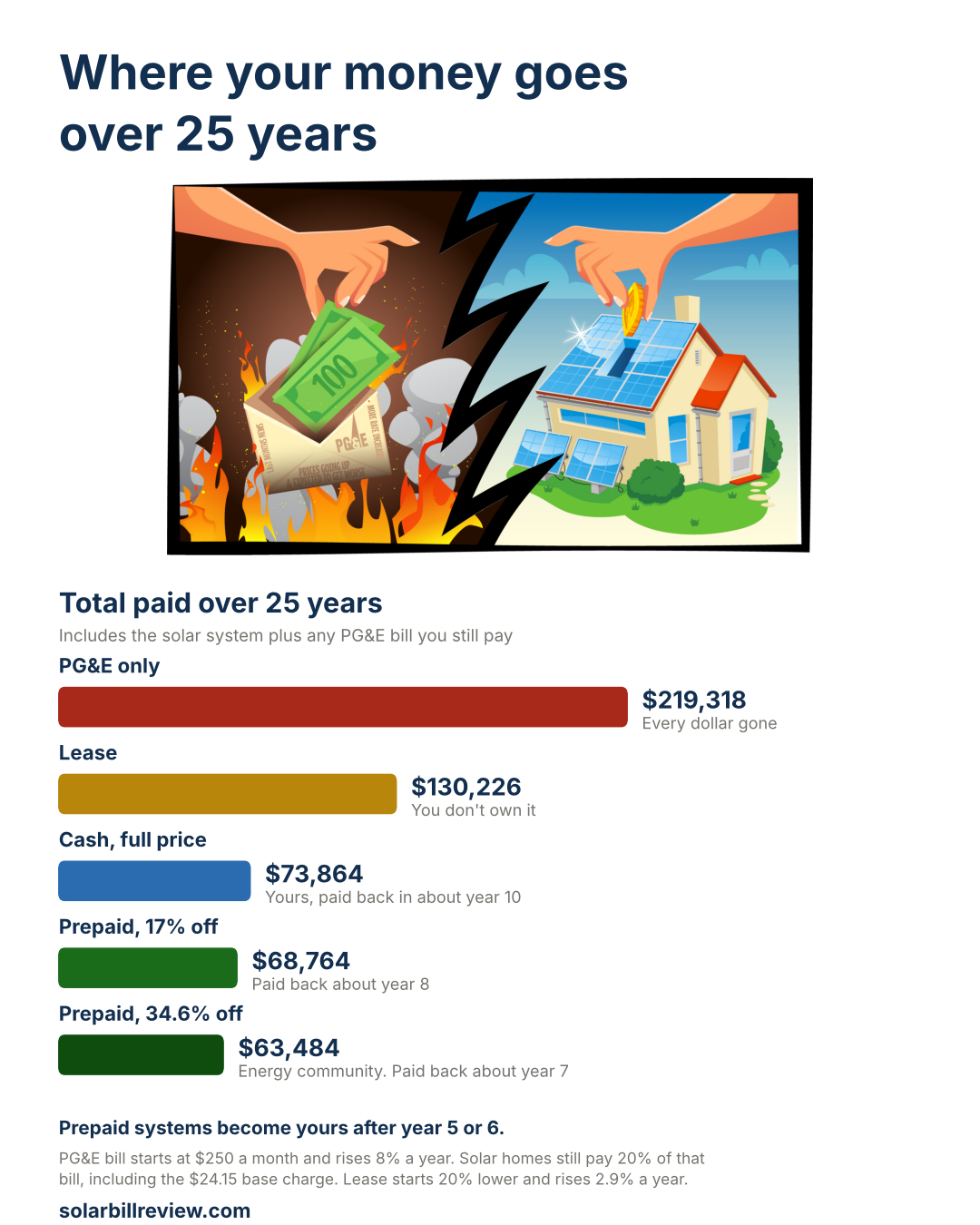
We built this as a worst case, so nothing is left out:
- The full price of the system, paid on day one.
- PG&E's $24.15 monthly base charge, every month, for all 25 years.
- The 20% of your bill that solar does not wipe out. Most of it shows up November through February, when days are short and panels make less.
- PG&E's prices rising 8% a year on everything you still pay them.
Even with all of that counted, every way of going solar comes out far ahead of staying with PG&E alone.
The bottom line
The homeowner credit is gone, but a discount on day one is still here, with nothing to file and nothing to wait for. It is not expected to last past 2027. Want to see what it is expected to look like for your home? Free reviews at solarbillreview.com.
Fact check us: our sources
- The homeowner credit that ended: IRS, Residential Clean Energy Credit
- The business credit an investor claims: IRS, Clean Electricity Investment Credit
- The law itself: 26 U.S. Code § 48E
- The five-year rule: IRS, Instructions for Form 4255
- Energy communities and the extra 10 percentage points: U.S. Department of Energy, Energy Community Tax Credit Bonus
- PG&E prices for 2014, 2019 and today, with links to every original rate sheet: our How Solar Affects Your Bill page
- PG&E's current E-1 rate sheet
- Discounts of 17% to 34.6%: actual program quotes we ran for PG&E addresses in October 2026
- Lease payment increases and buyout costs: our own experience with clients' leases
This article is for general education. It is not tax, legal, or financial advice, and program terms can change after the date above.
Explore Topics
Written by
Bill Gurgol
Energy Consultant · Lic. 97591SP · (925) 967-8949
Bill Gurgol is an independent solar consultant who has worked inside the biggest installers and the smallest since 2014, and knows where both go wrong. He works with GOT WATTS, a Diamond Certified East Bay installer, because they held up to that scrutiny. Questions about your bill? Free reviews at solarbillreview.com.