Do Solar Panels Cause Dirty Electricity? Separating the Myth From the Measurements
We checked the measurement studies, the engineering standards, and the health research ourselves. The honest answer is not the flat no most solar companies give.

At Solar Bill Review we take our subscribers' questions seriously. A few years ago a family with a newborn asked us one we had never heard before: does solar power produce "dirty electricity," and could it affect the baby? After twelve years in this industry, that was a first. So instead of giving a quick answer, we went and read the measurement studies, the engineering standards, and the health research ourselves. Here is what we found, including the parts that are more complicated than a simple yes or no.
The Short Answer
If you are here because you are worried about your family, here it is up front.
Solar panels do not emit electromagnetic interference at all. Your inverter produces the same kind of 60-cycle magnetic field your refrigerator does, and at three feet it measures lower than your refrigerator does at the same distance. Nine feet away it is indistinguishable from the background level already present throughout your house. No health effect from this has ever been established, and the World Health Organization finds no scientific basis linking these fields to the symptoms attributed to them.
There is one real issue, and it is an equipment question rather than a health one. Solar inverters can interfere with radio reception. That is documented, it has known fixes, and this article explains it honestly rather than pretending otherwise.
If that is enough, you can stop reading here. If you want the measurements and the sources behind it, keep going.
First, What Does "Dirty Electricity" Actually Mean?
This is the part most articles skip, and it is the part that matters most.
"Dirty electricity" is not an engineering term. It does not appear anywhere in the IEEE or IEC vocabulary that electrical engineers use to describe power quality. It was popularized outside the engineering world, and it is usually measured with a meter that reports its results in proprietary "Graham/Stetzer units," sold alongside the plug-in filters that are supposed to fix it. There is no national or international exposure limit expressed in those units.
That does not mean there is nothing real underneath the term. There is. The measurable phenomena it points at have proper names: harmonic distortion, high-frequency voltage transients, and conducted electromagnetic interference. Those are measured in amps, volts, and decibels, against published limits.
So the honest way to answer this question is not to argue about whether solar makes "dirty electricity." It is to ask what a solar system actually puts onto your home's wiring, and whether that falls inside the limits that exist. That is a question with real answers, and the rest of this article gives them.
So What Does a Solar System Actually Put on Your Wiring?
Start by separating the two halves of a solar system, because only one of them is relevant.
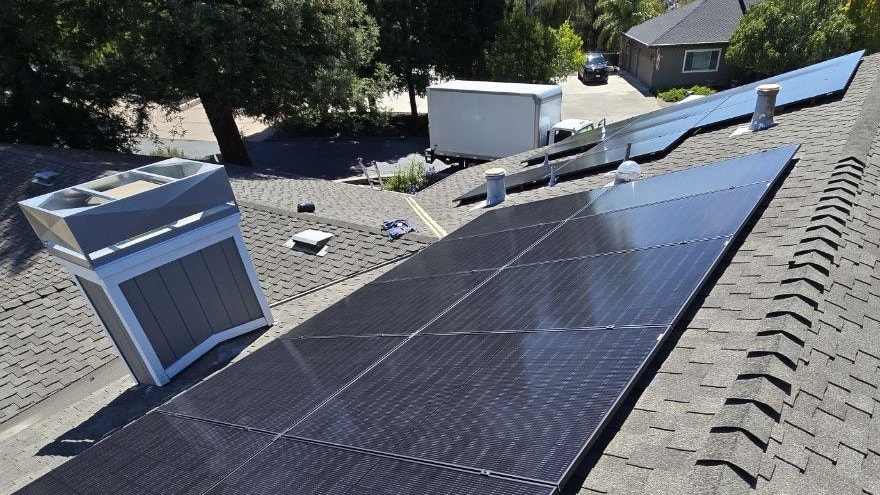
The panels on your roof are not a source. Solar panels produce direct current, which does not oscillate, and a field that does not oscillate does not radiate. This is not our opinion. The National Renewable Energy Laboratory, a U.S. Department of Energy national lab, states it flatly in its 2017 fact sheet on electromagnetic interference from solar arrays: "PV panels themselves do not emit EMI." When Massachusetts state agencies had panels measured directly, the reading three inches from the panel face was under one milligauss, about the same as the normal background level inside an average home.
The inverter is the only component that produces a measurable field, and the same NREL fact sheet describes exactly what kind: "Inverters, however, produce extremely low frequency EMI similar to electrical appliances." That phrase matters. Your inverter produces the same type of 60-cycle field your refrigerator, your furnace blower, and your existing house wiring have produced for as long as you have lived there.
Here are the actual measured numbers. In 2012 the Massachusetts Clean Energy Center commissioned an independent measurement study that included a residential 8.6 kW rooftop system, right in the range of a typical Tri-Valley home. The results:
- A few feet from the residential inverter: 6 to 10 milligauss
- Nine feet from that same inverter: back down to the 2 milligauss household background
- Inside the rooms directly beneath the roof panels: 0.2 to 1.4 milligauss
- Electric fields anywhere on the property: below the instrument's detection floor of 5 volts per meter
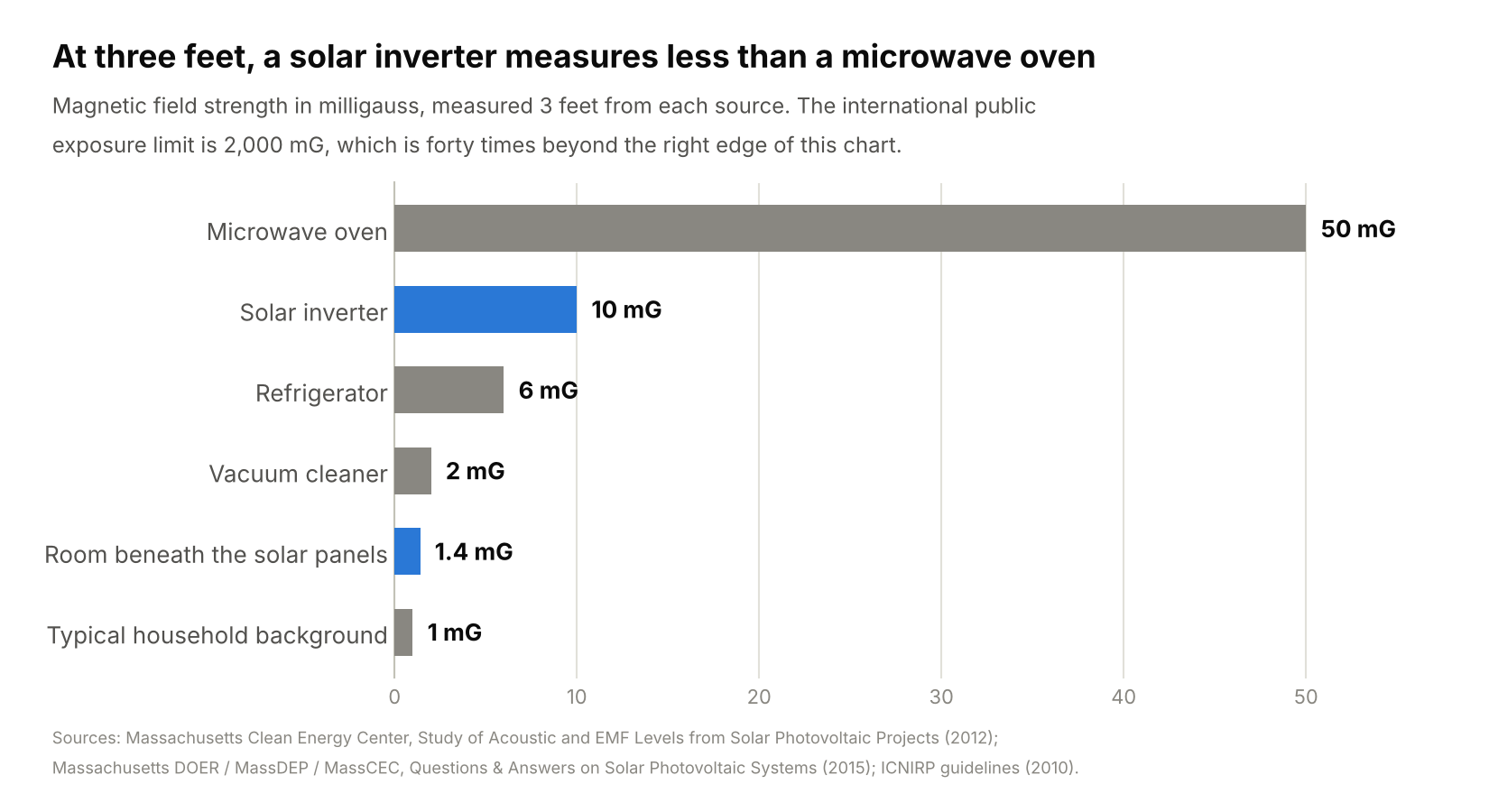
Read that chart twice. Standing three feet from your solar inverter puts you at roughly half of one percent of the international public exposure limit, and in the same neighborhood as the refrigerator you already own. The field also drops off by the inverse cube of the distance, meaning it falls away faster than most people assume. Nine feet is enough to put you back at the same level as the rest of your house. For perspective on the far end of that scale, the level at which a pacemaker can experience interference is above 1,000 milligauss, one hundred times what we are talking about here.
NREL put the same point a different way when it analyzed a PV inverter's maximum expected field strength at a distance of 100 feet. Its description: "very low, comparable to the field strength of a cell phone a mile away."
Which Rules Actually Govern This, and Which Ones Do Not
Most articles on this subject reach for California's Title 24 solar mandate. We did too, in the first version of this post, and we had it wrong. It is worth being precise here, because a confident wrong citation is worse than no citation at all.
Title 24 of the California Code of Regulations is the California Building Standards Code. It has several parts, and two of them matter here, doing two completely different jobs.
Part 6 is the California Energy Code, also called the Building Energy Efficiency Standards. Section 150.1(c)14 is the rule requiring solar on new homes. It arrived with the 2019 code, effective January 1, 2020, and it is now carried in the 2025 Energy Code, effective January 1, 2026. Two things about it get misstated constantly. First, the California Energy Commission writes and adopts this code, but it is your city or county building department that enforces it, through plan check and field inspection. Second, it does not apply to "all new homes." It applies to newly constructed low-rise residential buildings, meaning single-family and duplex homes plus multifamily buildings of three habitable stories or fewer. And it carries real exemptions: homes with less than 80 contiguous square feet of usable solar access, calculated system sizes under 1.8 kW, structural snow-load limits, and approved community solar programs. Pairing a battery of at least 7.5 kWh usable capacity allows the required array to shrink by 25 percent.
Now the part that matters for this article. The Energy Code says nothing whatsoever about electrical noise, harmonics, interference, or power quality. Not one word. It is an efficiency and system-sizing standard. Anyone citing Title 24 to prove your solar system will not disturb your home's wiring is citing the one code in California with no bearing on the question.
Part 3 is the California Electrical Code, and this is where electrical safety actually lives. It adopts the National Electrical Code with California amendments. Article 690 covers photovoltaic systems specifically: conductor sizing, disconnects, grounding, rapid shutdown, and labeling. Article 705 covers connecting your system to your existing electrical service. This is what your inspector is working from when he signs off on your install.
And the rules that genuinely govern what your system puts onto your wiring are not in Title 24 at all. They are these four:
IEEE 1547-2018 is the interconnection standard for distributed energy resources, and it is the one that sets real numbers. It caps total rated current distortion at 5 percent, limits DC injection to 0.5 percent of rated current, and sets individual harmonic limits out to the 50th harmonic, which at 60 cycles means 3,000 hertz.
UL 1741, with Supplement SB, is the product listing every grid-tied inverter must carry. Supplement SB is the specific testing path that demonstrates the inverter conforms to IEEE 1547-2018.
PG&E Electric Rule 21 is the interconnection tariff in our service territory. It requires a UL 1741 SB listed smart inverter on every new system connected to PG&E.
FCC Title 47, Part 15, Subpart B regulates radio-frequency emissions from electronic equipment. Residential equipment, your inverter included, must meet the stricter Class B limits, which cap conducted emissions across the range from 150 kilohertz upward.
If anyone tells you solar is unregulated on this point, those four are your answer. If anyone tells you Title 24 settles it, they have not read Title 24.
Now the Part Most Solar Companies Will Not Tell You
Everything so far has been about magnetic fields and the rules that govern them, and on those questions the answer really is reassuring. But there is a second, completely separate question hiding inside the "dirty electricity" worry, and the honest answer there is not a flat no. It is "yes, within limits, and here is exactly where those limits run out."
This is an equipment question, not a health question. Keep the two apart as you read.
Where the rules actually stop
Look back at the four standards in the last section and notice where their coverage begins and ends. IEEE 1547 sets harmonic limits out to the 50th harmonic, which is 3,000 hertz. FCC Part 15 starts measuring conducted emissions at 150,000 hertz. Between those two numbers, roughly 3 kilohertz up to 150 kilohertz, there is a band with almost no binding emission limits anywhere in the world.
Solar inverters typically switch at 15,000 to 20,000 hertz. That is inside the gap.
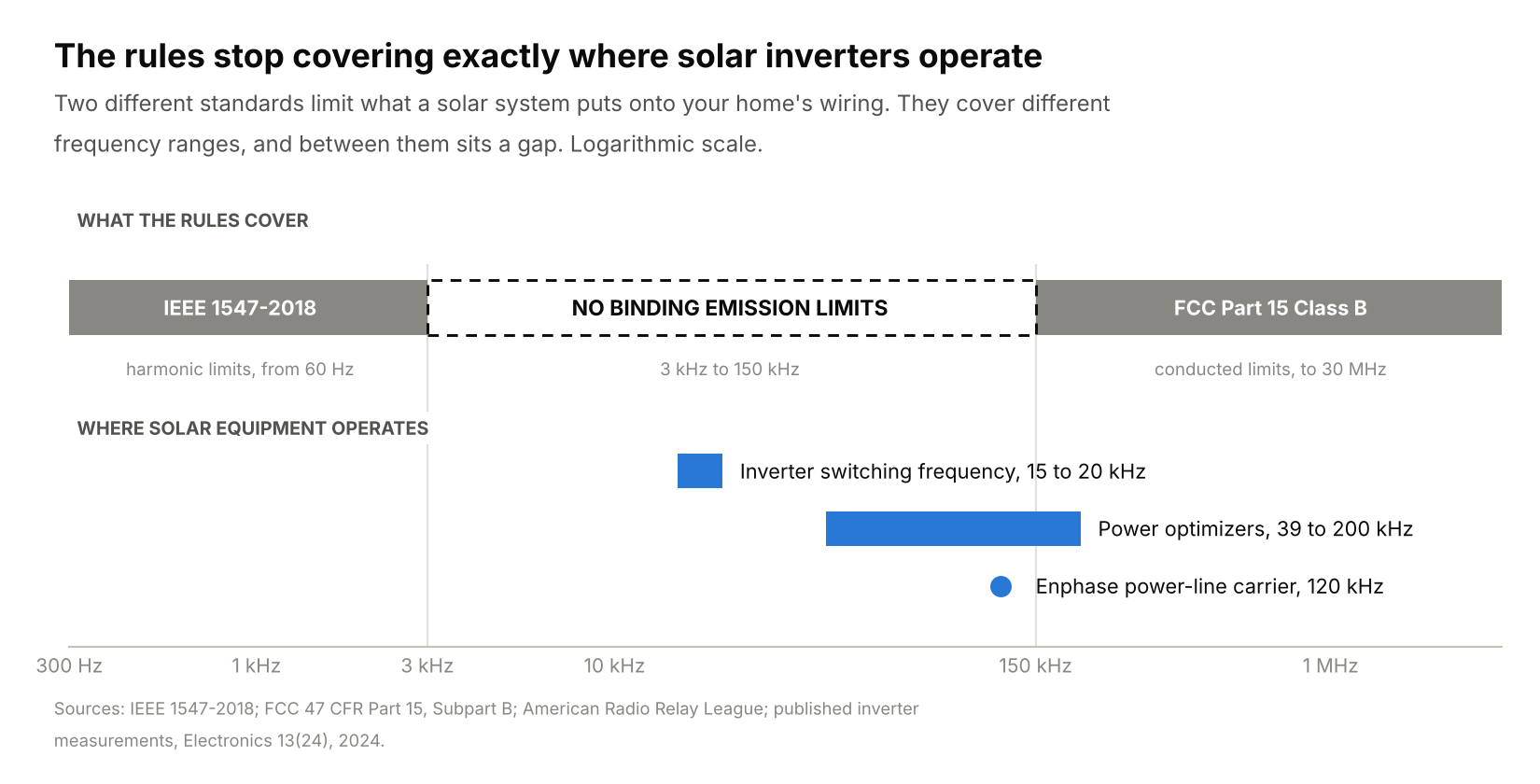
This is not a scandal we are revealing. Power engineers know about it and have been publishing on it for years. A 2025 review in a peer-reviewed engineering journal calls the 2 to 150 kilohertz range "the Wild West of EMC." Published measurements put a Fronius string inverter at 14.1 milliamps at 20 kilohertz and an Enphase microinverter at 4.08 milliamps at the same frequency. Enphase microinverters also communicate over your home's AC wiring using a carrier at 120 kilohertz, which sits just below the 150 kilohertz floor where the FCC's conducted limits begin.
So if somebody plugs a meter into a bedroom outlet and gets a reading, they are probably not imagining it. They are reading real switching-frequency content in a band that is genuinely under-regulated.
What that actually causes, and what it does not
What it is documented to cause is radio interference. The American Radio Relay League, the national association for amateur radio operators, maintains a standing page on solar interference and names SolarEdge, Enphase, and Generac equipment in it. Its finding is that inverter noise is radiated primarily by the DC wiring running up to your panels, with fundamentals in the 18 to 60 kilohertz range, and that power optimizers operate from 39 to 200 kilohertz and can emit even when the system is not producing power. A 2019 Swedish measurement found solar interference cut AM radio communication range to less than half. A documented case in the Netherlands involved a garage door opener that stopped working.
Nor is compliance a given. A European market surveillance campaign tested 55 grid-connected PV inverters and optimizers and found only 9 percent fully compliant with the applicable emissions standards.
What this is not documented to cause is a health effect. Those are different claims requiring different evidence. A garage door opener is not a person.
Your rights here, which nobody explains
Under FCC rules your inverter is what is called an unintentional radiator, and it operates on a non-interference basis. In plain terms, it has no protected right to interfere with anybody. If it causes harmful interference and the FCC notifies the operator, the equipment has to stop until the problem is corrected. That obligation lands on you as the system owner, which is a good reason to care who installs it.
What actually fixes it
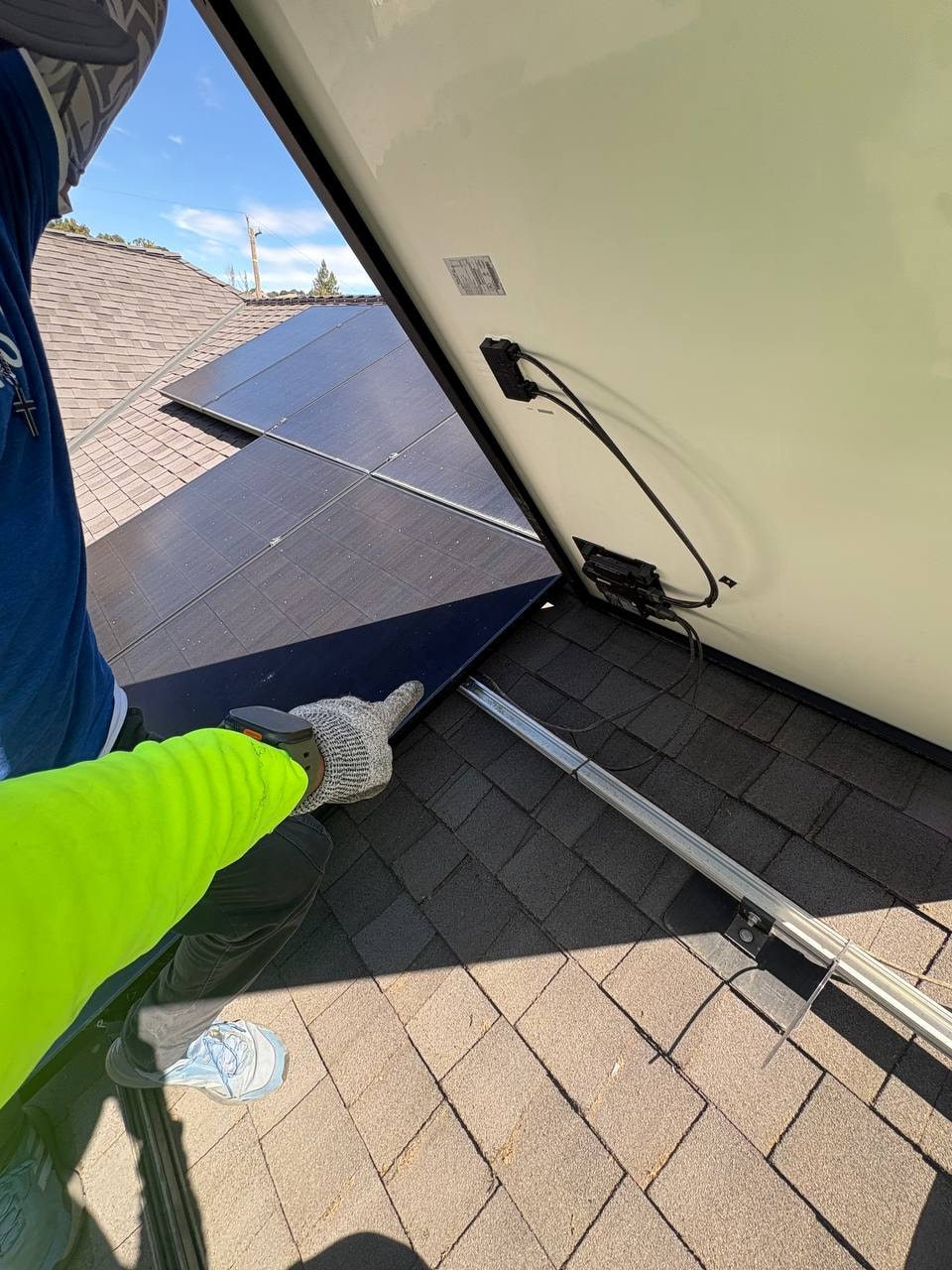
Nearly all of it is installation workmanship rather than brand:
- Proper equipment grounding and bonding, including the module frames. Published measurements show correct frame grounding eliminates resonances below 5 megahertz.
- Keeping the DC positive and negative conductors tightly paired, which minimizes the loop area that acts as an antenna.
- Metallic conduit on DC runs rather than cable run in free air.
- Short leads, disciplined cable management, no accidental loops.
- Ferrite cores on optimizer inputs where needed, which measurements show significantly reduce emission peaks.
None of those are product claims. They are things a careful installer does and a rushed one skips, and they are the real reason installation quality matters more here than the badge on the equipment.
One thing you cannot opt out of
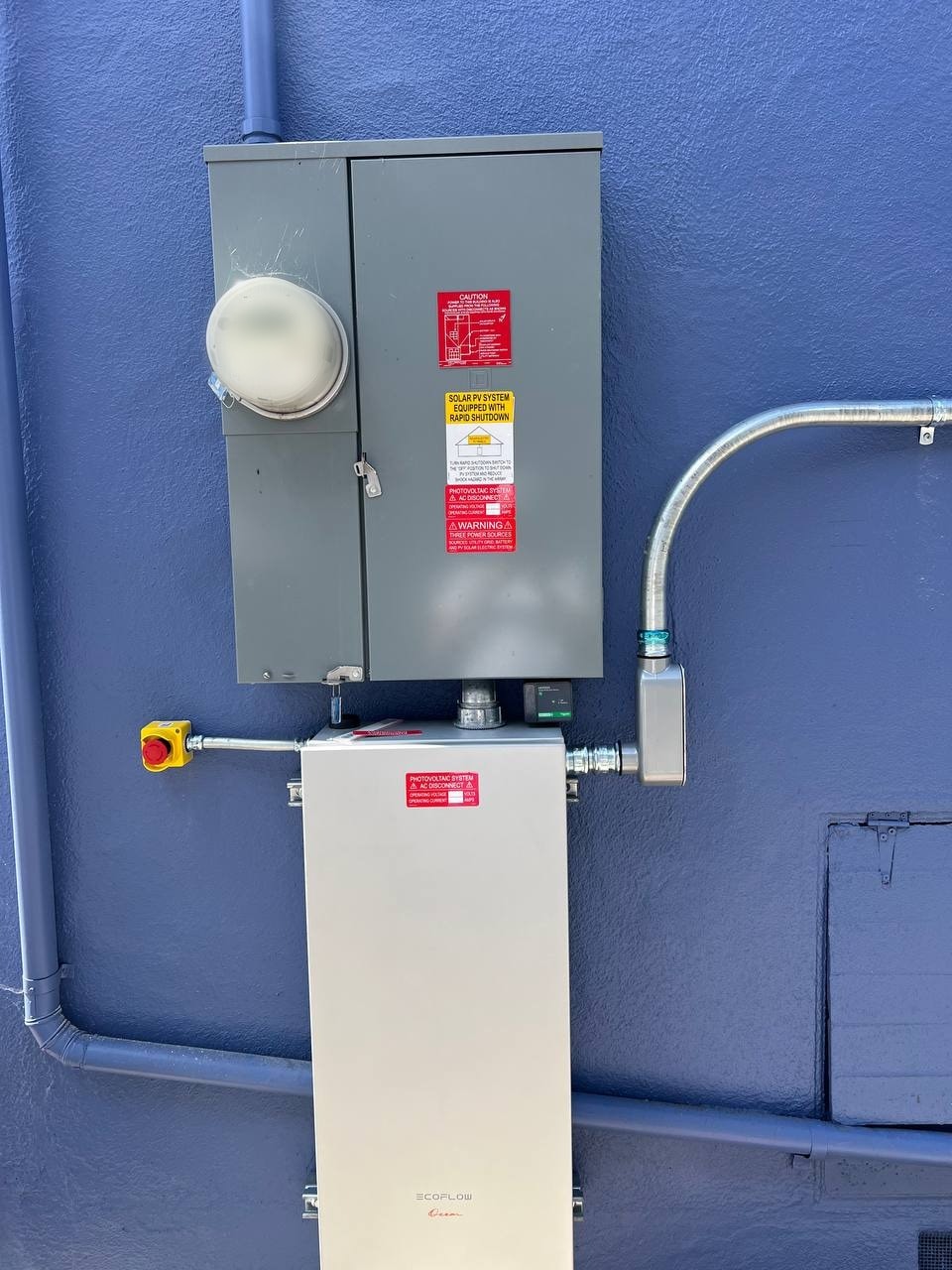
Homeowners who learn all this sometimes ask for a plain string inverter with no electronics on the roof, since that is the lowest-emission configuration. On a California rooftop array, you generally cannot have it. National Electrical Code 690.12 requires rapid shutdown, bringing conductors inside the array boundary down to 80 volts or less within 30 seconds, and in practice that means module-level electronics or a listed hazard control system. That is a firefighter safety rule and it is not negotiable. What you can insist on is that the workmanship above is done correctly.
Where we stand. We are independent consultants, not the installation crew, so we are not going to make promises on an electrician's behalf. Here is what we will do. We will raise this with you before you sign rather than after. If interference is ever reported on your system, we will help you document it and get it in front of the installer and the equipment manufacturer, who are the parties who can actually act on it. And we will not tell you nothing can be done, because that is not true. Grounding and bonding corrections, ferrite chokes, DC cable routing, and manufacturer firmware updates have all resolved real cases.
What About People Who Say They Are Sensitive to EMFs?
This question deserves a straight answer rather than a brush-off, so here is one.
The symptoms people describe are real. The World Health Organization says so directly, and the list is consistent across countries: headaches, fatigue, difficulty concentrating, sleep disturbance, skin sensations, nausea. Nobody serious disputes that people experience these things, and for some of them the symptoms are genuinely disabling.
What has not held up is the attributed cause.
Researchers have tested this the only way it can honestly be tested, with blinded provocation studies where the person does not know whether the field is switched on or off. A systematic review published in 2005 pooled 31 such experiments covering 725 people who reported sensitivity. An updated review in 2010 covered 46 experiments and 1,175 people. The result both times was the same. Participants could not tell when they were being exposed, and their symptoms tracked whether they believed they were exposed rather than whether they actually were.
The World Health Organization's conclusion is blunt. "EHS has no clear diagnostic criteria and there is no scientific basis to link EHS symptoms to EMF exposure," and "well controlled and conducted double-blind studies have shown that symptoms were not correlated with EMF exposure."
That finding is not an accusation. Expecting something and then feeling it is ordinary human wiring, not dishonesty, and it is the entire reason blinded studies exist.
On "dirty electricity" specifically
There is exactly one systematic review of the concept itself, published in Frontiers in Public Health in 2016. It examined 25 publications and reached two findings worth quoting directly. On the meter that most of these claims rest on, it found "no evidence for 50 Graham/Stetzer units as a safety threshold being anything more than arbitrary." On the health evidence overall, it concluded that "the available evidence for DE as an exposure affecting human health at present does not stand up to scientific scrutiny."
The one piece of evidence worth taking seriously
If somebody challenges all this, they will raise the same thing, and they are entitled to. In 2002 the International Agency for Research on Cancer classified extremely low frequency magnetic fields as Group 2B, possibly carcinogenic to humans. That is a real classification by a real body, and we are not going to pretend otherwise.
Two things are worth understanding about it.
First, what Group 2B means. It is a statement about the strength of the evidence, not the size of the risk. IARC uses it when there is limited evidence in humans and less than sufficient evidence in animals. What drove it was an observed association with childhood leukemia in homes with higher measured magnetic fields. The National Cancer Institute's summary of the science is that no mechanism by which these fields could cause cancer has ever been identified, and the National Institute of Environmental Health Sciences describes the overall evidence for human health risk as weak.
It is worth being precise about what those studies measured, because that is the part that matters if you have a child at home. They looked at average magnetic field exposure in the rooms where a child actually lives and sleeps, measured over time, not a spot reading taken next to a piece of equipment. The association appeared above roughly 3 to 4 milligauss of sustained exposure. As the measurements earlier in this article show, a solar inverter's contribution falls back to a home's own background level within about nine feet. Unless a crib sits three feet from the inverter, solar adds nothing to the exposure a child actually lives in. And nobody puts an inverter three feet from a crib.
Second, and this is the part that actually bears on your decision. That classification covers power-frequency magnetic fields from the use of electricity. All of it. Your existing house wiring, your refrigerator, the service drop running from the pole to your roofline, the grid power you are using to read this. Nothing about a solar system places it in a different category from the electricity it replaces. If the 2002 classification is a reason to avoid solar, it is equally a reason to avoid your kitchen.
What we actually do about it
If you raise this during design, we will put it in the system design request before anything is installed and ask that the inverter be sited away from bedrooms and primary living spaces. We cannot guarantee a location. Roof geometry, conduit runs, service panel position, and code clearances all constrain where that box can go, and the installer makes that call. But it costs nothing to ask, the field falls to background within about nine feet anyway, and asking early is the only time it is easy. Once the conduit is run and the system is commissioned, moving an inverter is a real job rather than a preference.
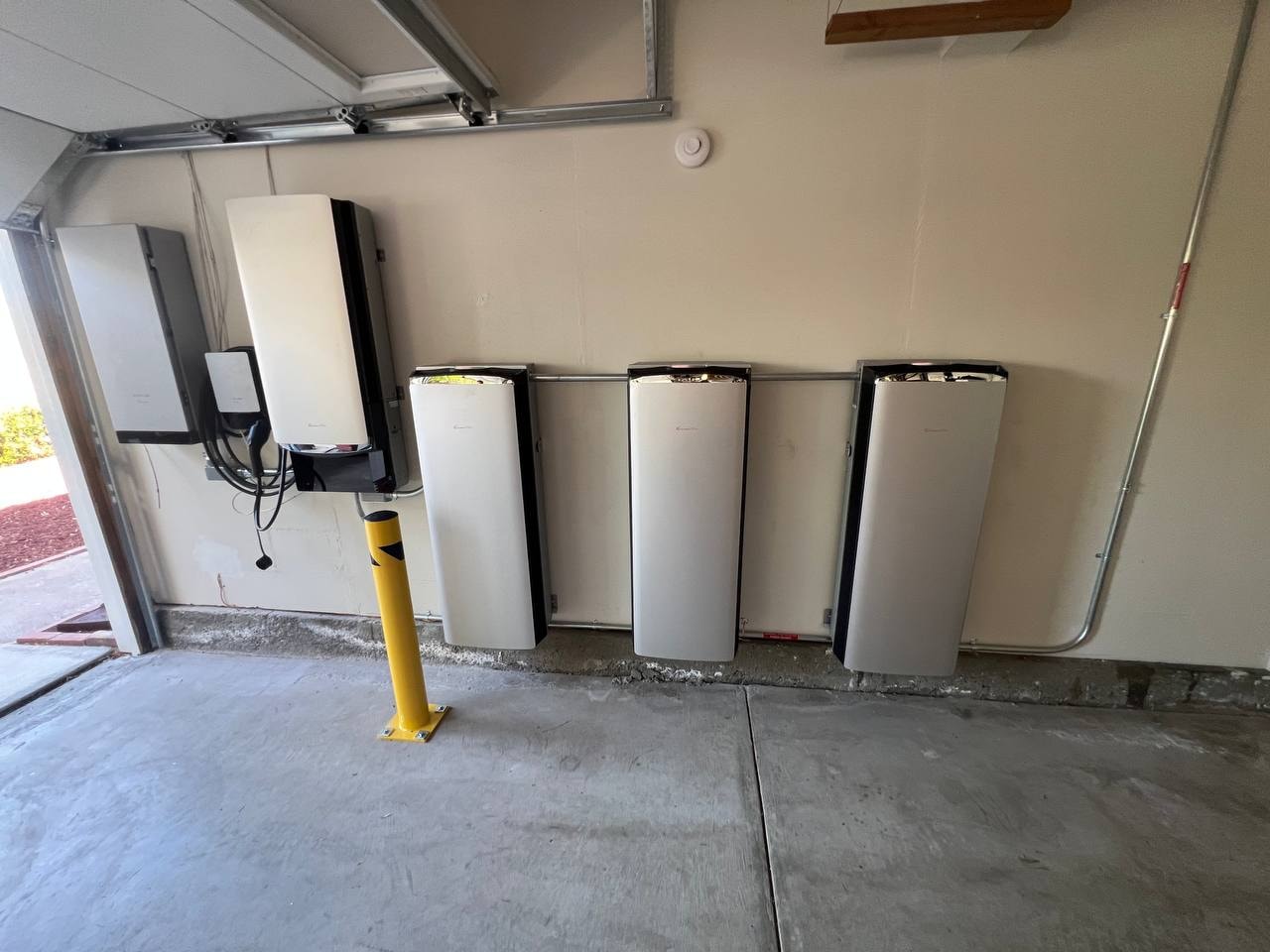
But we also tell you the truth about what that does and does not accomplish. Moving the inverter reduces the magnetic field at that wall. It does essentially nothing about conducted noise on your branch circuits, because that travels the wiring to every outlet in the house regardless of where the box is mounted. Anyone selling you inverter placement as the solution to "dirty electricity" is either confused or counting on you to be.
The Bottom Line
Here is the short version of everything above.
Solar panels do not emit electromagnetic interference. The inverter produces a 60-cycle magnetic field of the same kind your house wiring has always produced, measured at 6 to 10 milligauss three feet away and falling to household background within nine feet. That is below your refrigerator at the same distance, and roughly half of one percent of the international public exposure limit.
"Dirty electricity" is not an engineering term and has no defined unit. The one systematic review of the concept found that the evidence for it affecting human health does not stand up to scrutiny. The World Health Organization finds no scientific basis linking EMF exposure to the symptoms attributed to it, while being equally clear that those symptoms are real.
There is one genuine gap, and it is an equipment question rather than a health one. Between 3 and 150 kilohertz the emission limits run out, solar inverters switch inside that band, and documented radio interference has resulted. Careful installation workmanship is what addresses it.
So the honest answer to the original question is not a flat no. It is that a solar system puts a small, measurable, well-characterized amount of electrical activity onto your wiring, that the health concern attached to it has not survived testing, and that the real problem it can cause is a radio one with known remedies.
We would rather give you that answer than an easier one. If a company tells you there is nothing here worth discussing, they either have not looked into it, or they are hoping you will not.
Still Have Questions?
This article exists because one family asked a question nobody else had asked us in twelve years. If you have one, ask it. We would rather spend twenty minutes on an awkward question than have you sign anything you are unsure about.
Solar Bill Review is the independent consulting practice of Bill Gurgol, working with GOT WATTS in the Tri-Valley.
Call or text Bill directly at 925-967-8949, or email bill@solarbillreview.com.
Sources
Every factual claim in this article traces to one of the following.
Measurements and field levels
- Deline, C. and Phillips, S. Electro-Magnetic Interference from Solar Photovoltaic Arrays. National Renewable Energy Laboratory, NREL/FS-5J00-67440, 2017.
- Guldberg, P.H., Tech Environmental, Inc. Study of Acoustic and EMF Levels from Solar Photovoltaic Projects. Prepared for the Massachusetts Clean Energy Center, 2012.
- Massachusetts Department of Energy Resources, MassDEP and MassCEC. Questions and Answers: Ground-Mounted Solar Photovoltaic Systems, 2015.
- International Commission on Non-Ionizing Radiation Protection. Guidelines for Limiting Exposure to Time-Varying Electric and Magnetic Fields, 1 Hz to 100 kHz, 2010.
Codes and standards
- California Energy Commission. 2025 Building Energy Efficiency Standards, Title 24 Part 6, Section 150.1(c)14.
- California Building Standards Commission. Title 24 Part 3, California Electrical Code, adopting NFPA 70 National Electrical Code, Articles 690 and 705.
- IEEE Standard 1547-2018, Interconnection and Interoperability of Distributed Energy Resources with Associated Electric Power Systems Interfaces.
- UL 1741, Inverters, Converters, Controllers and Interconnection System Equipment for Use With Distributed Energy Resources, with Supplement SB.
- Pacific Gas and Electric Company, Electric Rule 21 interconnection tariff.
- Federal Communications Commission, 47 CFR Part 15, Subpart B, Unintentional Radiators.
Power quality and interference research
- Pinto, J., Grasel, B. and Baptista, J. Analysis of Supraharmonics Emission in Power Grids: A Case Study of Photovoltaic Inverters. Electronics 13(24), 2024.
- Mahmud, R. and Abolhassani, M. Ensuring electromagnetic compatibility in grid-connected power converters. Energy Reports 14, 2025.
- Kane, M.M., Taylor, N. and Månsson, D. Electromagnetic Interference from Solar Photovoltaic Systems: A Review. Electronics 14(1), 2025.
- American Radio Relay League. Solar. arrl.org/solar
- European Commission EMC Administrative Cooperation Working Group, market surveillance campaign on grid-connected photovoltaic inverters, 2014.
Health research
- World Health Organization. Electromagnetic fields and public health: electromagnetic hypersensitivity.
- World Health Organization. Electromagnetic fields and public health: exposure to extremely low frequency fields.
- Rubin, G.J., Das Munshi, J. and Wessely, S. Electromagnetic hypersensitivity: a systematic review of provocation studies. Psychosomatic Medicine 67, 2005.
- Rubin, G.J., Nieto-Hernandez, R. and Wessely, S. Idiopathic environmental intolerance attributed to electromagnetic fields: an updated systematic review of provocation studies. Bioelectromagnetics 31(1), 2010.
- de Vocht, F. and Olsen, R.G. Systematic Review of the Exposure Assessment and Epidemiology of High-Frequency Voltage Transients. Frontiers in Public Health 4:52, 2016.
- International Agency for Research on Cancer. Non-Ionizing Radiation, Part 1: Static and Extremely Low-Frequency Electric and Magnetic Fields. IARC Monographs Volume 80, 2002.
- National Cancer Institute. Electromagnetic Fields and Cancer.
- National Institute of Environmental Health Sciences. Electric and Magnetic Fields Associated with the Use of Electric Power: Questions and Answers.
Explore Topics
Written by
Bill Gurgol
Energy Consultant · Lic. 97591SP · (925) 967-8949
Bill Gurgol is an independent solar consultant who has worked inside the biggest installers and the smallest since 2014, and knows where both go wrong. He works with GOT WATTS, a Diamond Certified East Bay installer, because they held up to that scrutiny. Questions about your bill? Free reviews at solarbillreview.com.