

PG&E NBT Export Rates 2026: What Your Solar Actually Earns, Hour by Hour
PG&E publishes 576 different prices for the solar you send to the grid, and the best hour of the year pays 136 times what the worst one pays. Here is what that means for how you should size a system.
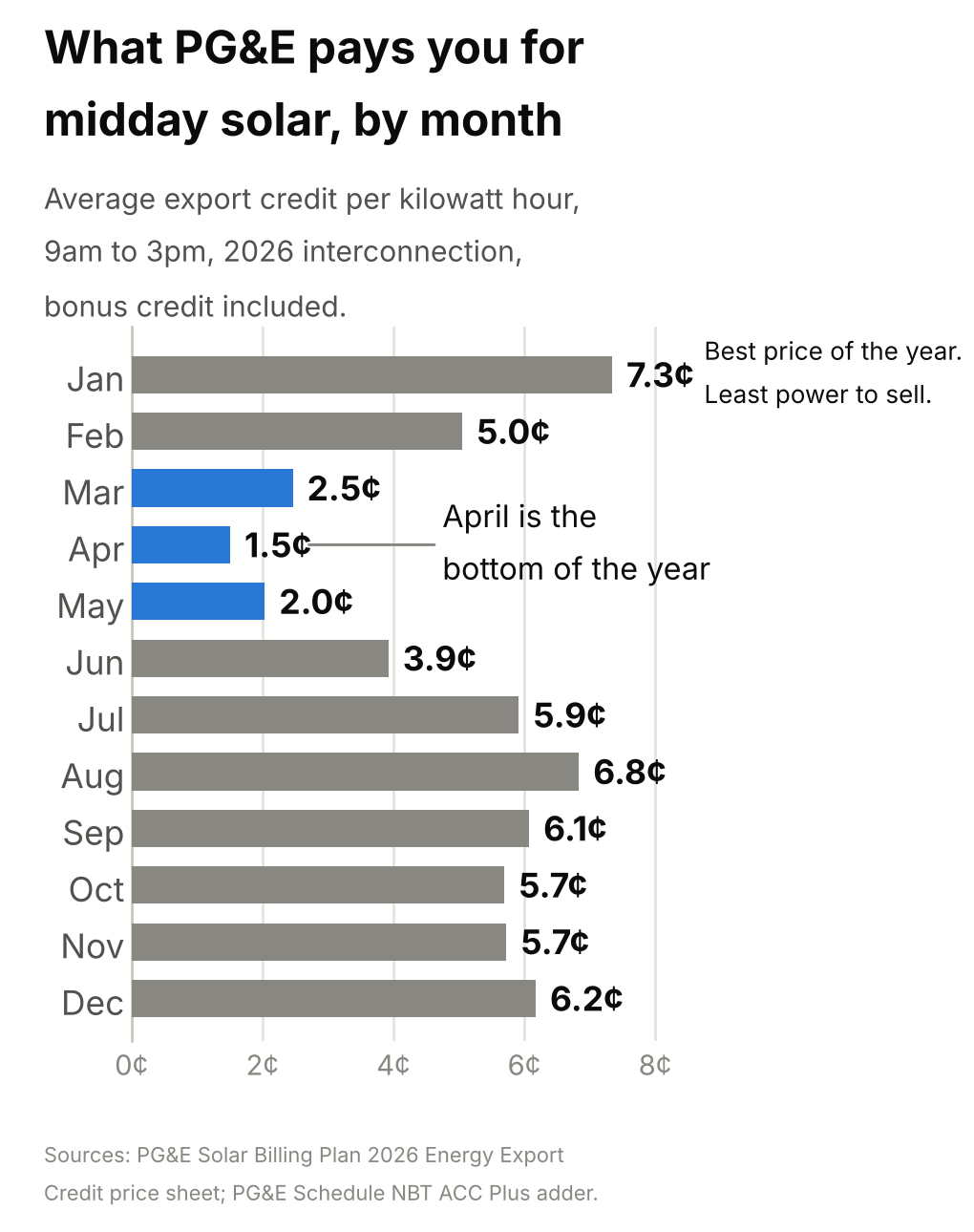
Send a kilowatt hour to PG&E from your solar panels at 3pm on an April Saturday and your bill shows two credits for it. The export credit is $0.00002, two hundredths of one cent. A second line, the bonus credit, adds 0.88 cents. Together, just under nine tenths of a cent. Send that same kilowatt hour, off the same roof, through the same meter, at 7pm on an August Saturday, and it is worth $1.20.
Those are not estimates or projections. They come straight out of PG&E's own 2026 Energy Export Credit price sheet, which publishes a separate value for all 576 combinations of hour, month, and weekday or weekend, plus the bonus credit Schedule NBT adds on top of every one of them. The best hour of the year pays 136 times what the worst hour pays.
That ratio is the whole ballgame, and most people buying solar in California right now have never seen it. Under the old rules a kilowatt hour was a kilowatt hour, so the only question worth asking was how many of them you needed. Under the Net Billing Tariff, which almost everyone calls NEM 3, the question that actually matters is when yours shows up. Get that wrong and you will pay for panels that make their power at the exact hours PG&E has decided it does not want any.
From NEM to NEM 2.0 to NBT: How We Got Here
Here is how we got here, because where you sit depends on when you signed. The original program ran from 1996 until PG&E hit its cap on December 15, 2016, and it was as simple as it sounds. Most customers stayed on the old tiered rate, and a kilowatt hour sent to the grid came back as a kilowatt hour credit. One for one, no time of use requirement, and no charges your credits could not cover. NEM 2.0 took over from there until April 2023. Exports were still credited at the retail rate, but everyone had to move to a time of use plan, a $145 interconnection fee appeared, and a set of state mandated charges got attached to every kilowatt hour you pull from the grid that your solar credits are not permitted to touch. On PG&E those run about a penny and a quarter today. That is why a NEM 2.0 customer who produces more than they use still gets a bill.
The California Public Utilities Commission ended that for new customers in December 2022, and the replacement took effect for anyone whose interconnection application was submitted on or after April 15, 2023. That replacement is the Net Billing Tariff. Exports are no longer credited at what you pay. They are credited at what the power is worth to the grid at the exact hour you send it, calculated from a state model called the Avoided Cost Calculator. That is where those 576 numbers come from.
One more thing changed for everybody, no matter which program you are on. On March 1, 2026, PG&E replaced the old monthly minimum charge with a Base Services Charge. For most households it runs about $24 a month, and like the non-bypassable charges, your solar credits are not permitted to offset it. At typical usage it is roughly five times larger than those charges. And if you are on the original net metering, where there were never any non-bypassable charges, this is now the entire floor under your bill.
The practical effect is that your solar now has two completely different values depending on what happens to the electricity. A kilowatt hour you use inside your own house the moment it is made is worth whatever you would have paid PG&E for it, which on the rate plan NBT puts you on runs between 28 and 55 cents. A kilowatt hour you send out to the grid is worth whatever that chart says, which in the middle of a spring day is close to nothing. Same panel, same minute, two prices that are not remotely alike.
If your system was turned on before April 2023, you keep your original terms, but not forever. They run 20 years from your interconnection date, and the earliest California solar customers are reaching that mark now. When it expires, PG&E moves you onto the Net Billing Tariff automatically. There is no second round of net metering. If you are on NEM 2.0 today, protect it.
Your Price Sheet Depends On The Year You Applied
There is not one price sheet. There are four of them in force right now. PG&E publishes a separate set of 576 values for every interconnection application year, and the one that governs your account is the sheet from the year your application was submitted. A house that applied in 2023 and a house that applies this year are reading different price books, on the same street, in the same month, off the same grid.
Here is what that looks like in practice. On a September weekday at 7pm, the 2023 sheet pays $2.54 for a kilowatt hour. The 2026 sheet pays $0.60 for that identical hour. Four times the money for the exact same electricity. In August the gap is much narrower, $1.85 against $1.16. The state did not cut evenly. It took almost all of it out of September.
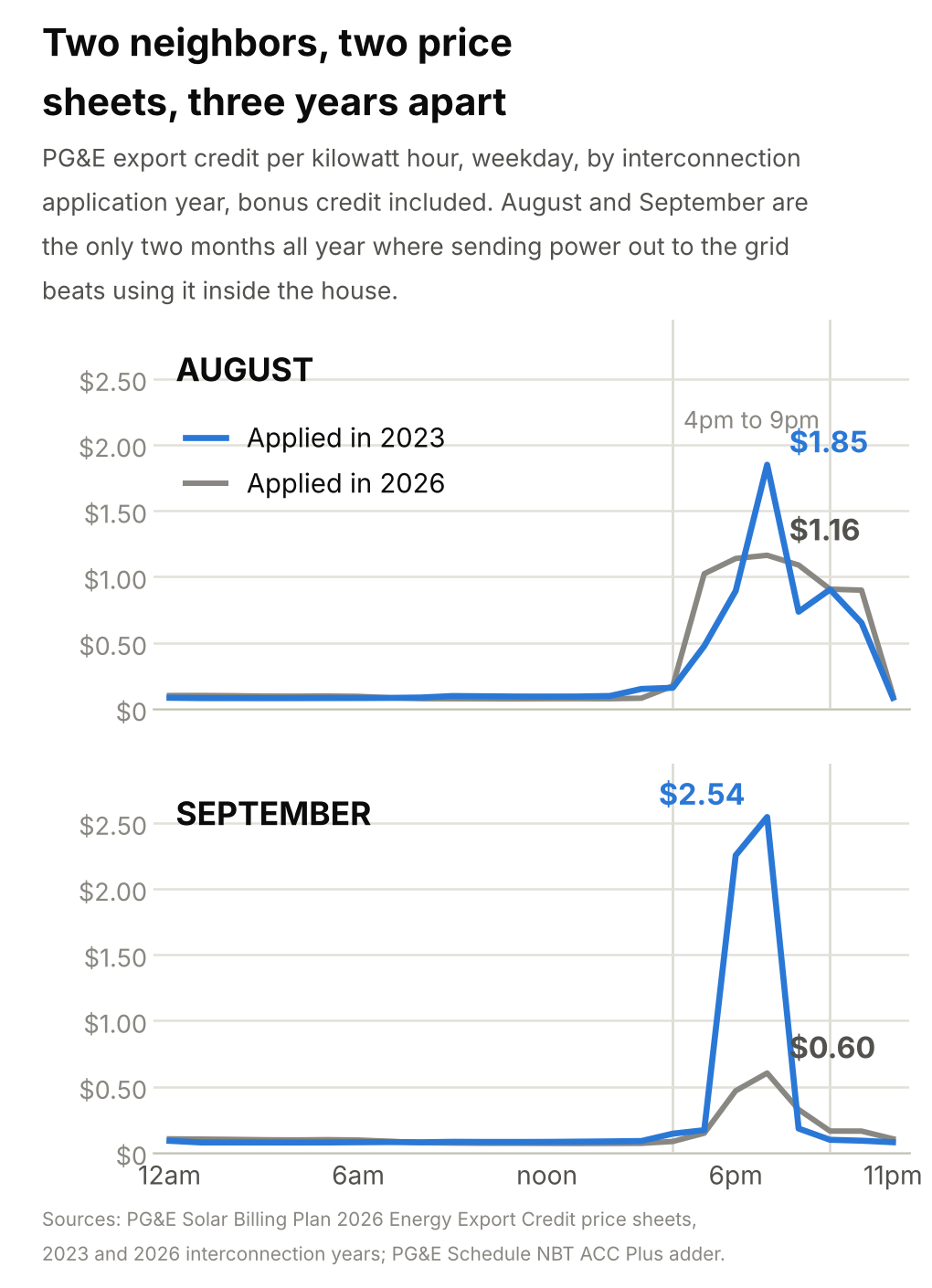
Before you conclude that the early customers simply won, average all 576 values on each sheet. The 2023 sheet comes out to 9.35 cents. The 2026 sheet comes out to 9.29 cents. They are six hundredths of a cent apart. The money did not disappear. It got rearranged. The older sheets stack it into a handful of evening hours. The newer sheets spread it thinner and wider.
There is one piece that does shrink every year, and it is not on those sheets at all. Schedule NBT pays a bonus credit on top of every exported kilowatt hour, residential only, locked for nine years from the day your system is switched on. A customer who applied in 2023 gets 2.2 cents. A 2025 customer gets 1.3 cents. A 2026 customer gets 0.88. Anyone applying in 2028 gets nothing at all. All in, the 2023 vintage averages about 11.6 cents against 10.2 cents today. That is the piece that genuinely erodes with time.
That rearrangement is the reason the battery conversation has changed so much in three years, and it is where this gets practical.
The Half Of Your Solar PG&E Never Touches
Everything above is about electricity you send away. But on a well designed system, most of the power never leaves the property. It runs the refrigerator, the air conditioning, the pool pump, the dryer, the car charger. That power is not credited at anything, because it is never sold. It is simply never bought.
That is the part that matters, because the money you keep is the retail price you did not pay. On E-ELEC, the rate plan the Net Billing Tariff puts you on, that runs from 28.5 cents off peak in winter up to 55.2 cents on a summer afternoon.
Now put the two numbers next to each other. On an April afternoon, a kilowatt hour you use inside your house is worth more than thirty times a kilowatt hour you send to PG&E. Same panel, same minute, same meter. The only difference is which direction the electricity went.
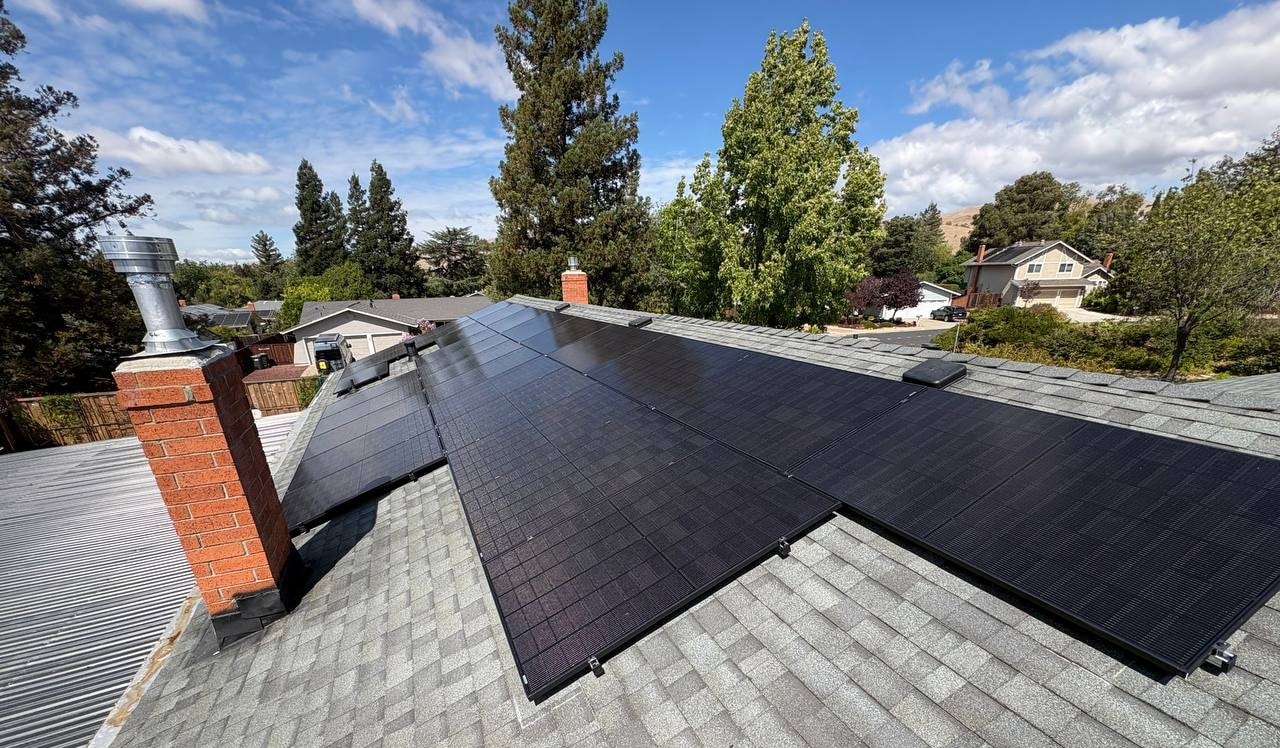
Here is the number underneath all of this. On a system with no battery, roughly a third of what the panels produce gets used inside the house at the moment it is made. The other two thirds leaves the property at the prices on those charts. That is why I size a system toward covering about half of a household's annual bill rather than chasing all of it. Half is where the return lands in a range most people are comfortable with. Chasing a hundred percent means building a much larger system whose extra production goes out the door during the exact hours it is worth the least.
That third is not a fixed number. It moves with when your house actually uses power. A pool pump running at midday, air conditioning through a Tri-Valley summer, a heat pump water heater, or a car charging in daylight can push self-consumption well past a third and the bill offset past half. Those houses exist, but they are the minority. A home that sits empty from seven to six, with a gas water heater and a car that charges at midnight, lands well below it. This is worth knowing before anyone sells you another panel, because shifting a load into the middle of the day costs you a timer setting.
What A Battery Actually Does
The pitch you will hear is that a battery lets you sell into the evening peak, when PG&E is paying over a dollar a kilowatt hour. That is real. It is also rarer than it sounds.
I compared all 576 values on the 2026 price sheet, bonus credit included, against what that same kilowatt hour would have saved you at the retail rate. Exporting wins in exactly fourteen of them. Every one falls in August or September, between 5pm and 10pm. Across a full year that is roughly 215 hours out of 8,760.
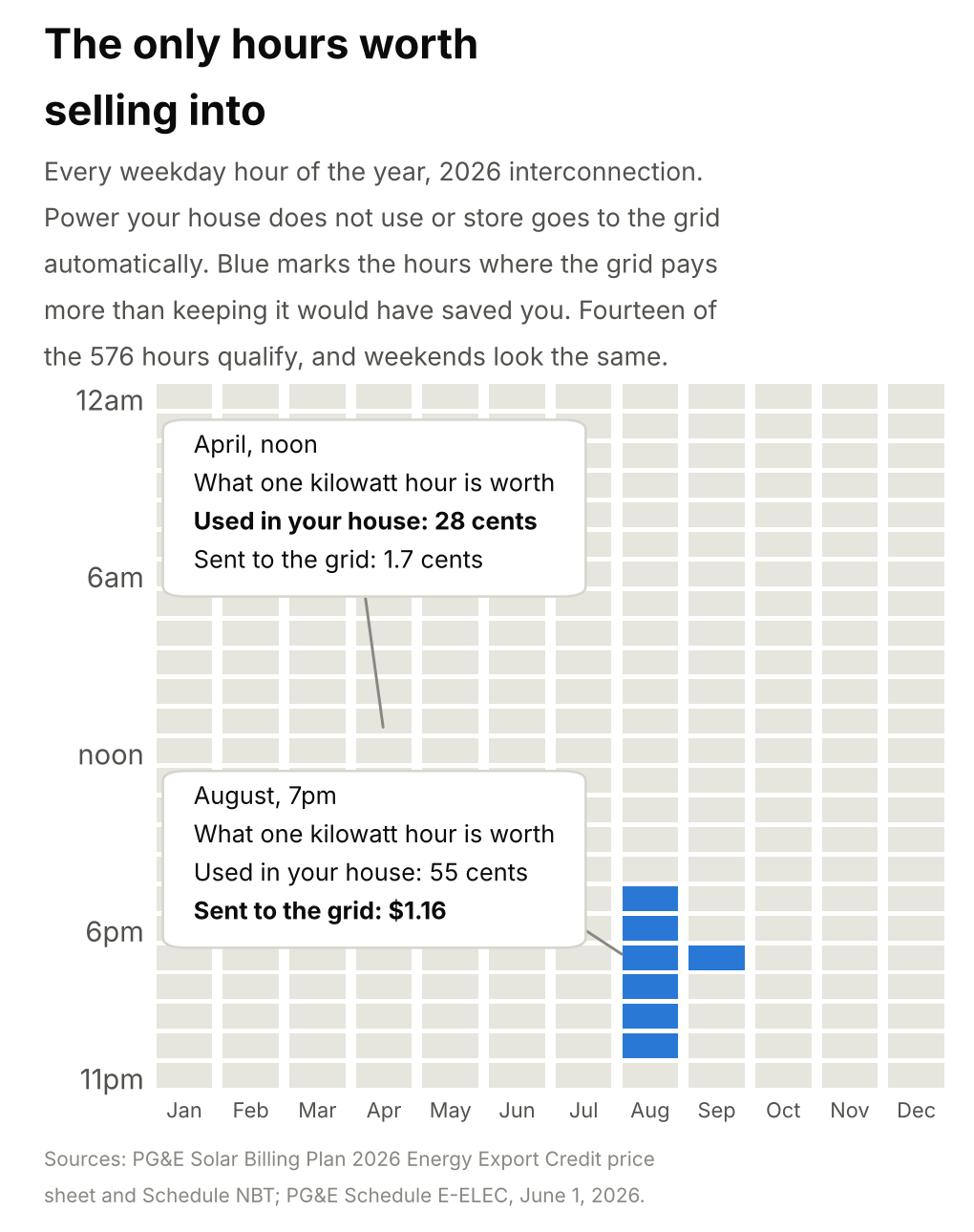
So selling into the peak is not what a battery is for. The real job is simpler than that. It takes the midday power that would have left your property for pennies and hands it back to you after four o'clock, when buying that same power from PG&E gets expensive.
Here is what that is worth. Sold at midday, a kilowatt hour of April solar brings about a cent and a half. Held until evening and used inside the house, that same kilowatt hour is worth 32 cents in winter, 55 cents in summer, and close to a dollar on an August evening. Averaged across the whole year, five cents becomes forty three.
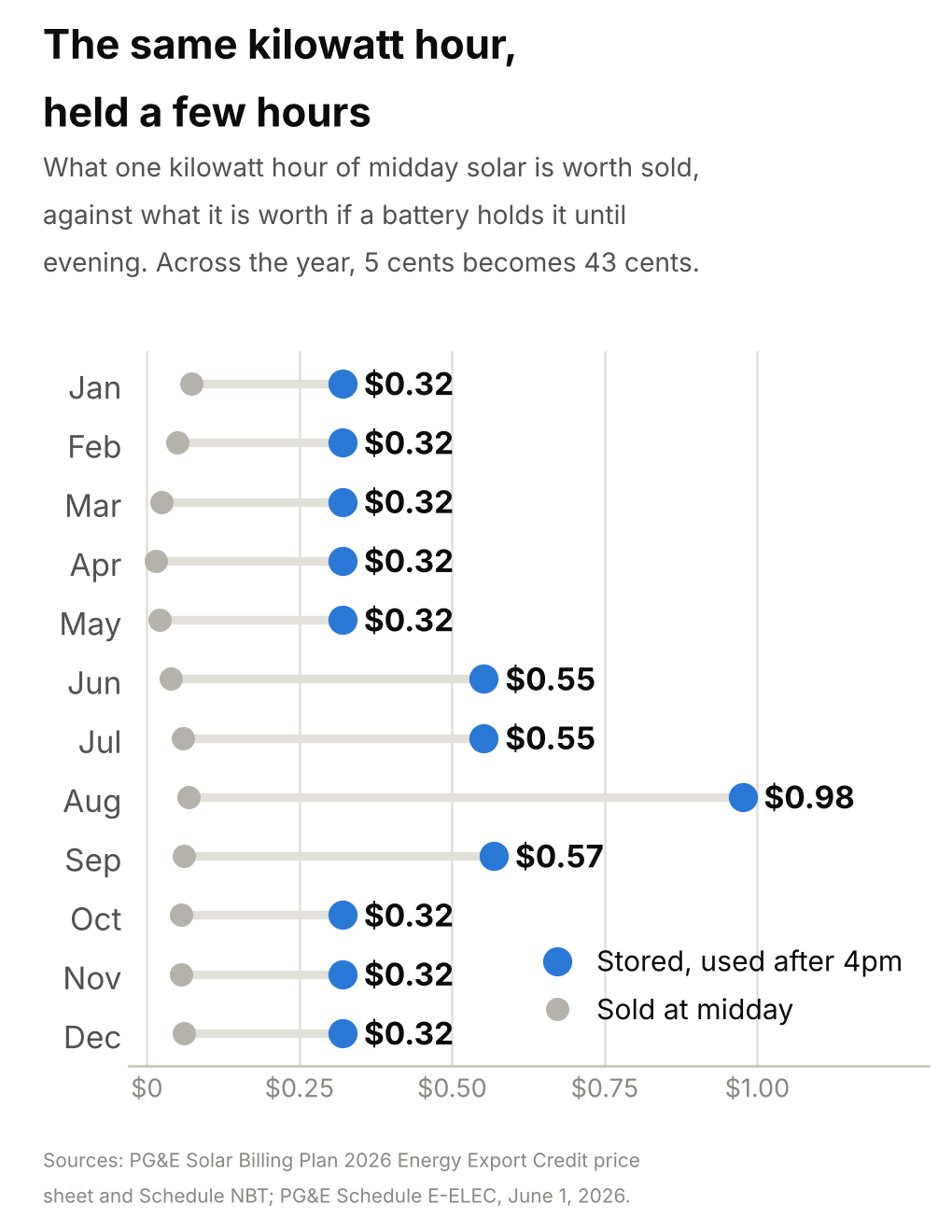
Put real numbers on it. Ten kilowatt hours of midday surplus, exported every day for a year, earns you about $177. The same ten kilowatt hours stored and used after four o'clock, which gives back about nine once you account for losses in the battery, is worth about $1,430. Same electricity, same roof. The only thing that changed is what hour of the day it got used.
That $1,430 is a ceiling, not a promise. It assumes the battery fills every single day and that the house actually draws it down between four and nine. On a Tri-Valley roof I reviewed this week, a December day produced 12 kilowatt hours while a July day produced 43. In December there is often not enough midday surplus to fill a battery at all. And none of this says anything about what the battery costs. This page is not going to tell you a battery pays for itself. That is a conversation with your own bill on the table.
The Bottom Line
Under the Net Billing Tariff, the size of your system matters less than the timing of your house. Panels producing into an empty home at noon in April are worth almost nothing. The same panels feeding a running air conditioner, or charging a battery that carries you through dinner, are worth more than thirty times that. Nothing about the hardware changed. Only the hour did.
So the first question is not how many panels. It is what your day actually looks like. When does the house wake up, when does it empty out, when does the car plug in, and what could move into daylight without anyone's life getting harder.
One more thing, and it is the part people underestimate. Waiting does not keep you neutral. If your electric bill is $3,300 a year, every year spent deciding is another $3,300 handed to PG&E while a system that would have covered a good share of it sits unbuilt. The shrinking bonus credit is worth tens of dollars a year. The waiting is worth thousands.
If you want someone to read your actual bill, hour by hour, and tell you honestly whether the numbers work for your house, that is what I do. Sometimes the answer is no. Call or text me at 925-967-8949, or email [email protected].
Solar Bill Review is the independent consulting practice of Bill Gurgol, working with GOT WATTS in the Tri-Valley.
Sources
- PG&E, Solar Billing Plan. Energy Export Credit price sheets for 2023 through 2026 interconnection application years.
- PG&E, Electric Schedule NBT. The Net Billing Tariff, including the bonus credit amounts by enrollment year and the nine year term.
- PG&E, Electric Schedule E-ELEC. Residential rates effective June 1, 2026.
- California Public Utilities Commission, Net Energy Metering and Net Billing. Program history and Decision 22-12-056.
- California Public Utilities Commission, CPUC Modernizes Solar Tariff to Support Reliability and Decarbonization. The nine year lock on export credits.
- California Public Utilities Commission, DER Cost-Effectiveness. The Avoided Cost Calculator, including the 2026 version adopted September 3, 2026.
- PG&E, Solar Bill. The 20 year legacy period for original net metering customers and the automatic transition at expiration, under CPUC Decision 14-03-041.
- PG&E, Base Services Charge.
- PG&E, Electric Schedule NEM2. The tariff in force from 2016 to April 2023.
Every source is PG&E's own filed tariff or the CPUC's own record. No solar company blogs, no review sites, no trade press. If someone wants to argue with a number in this post, they are arguing with the utility's own price sheet.
Related reading: The $24 You Can't Escape, on the fixed charge that solar credits are not permitted to touch.
Explore Topics
Written by
Bill Gurgol
Bill Gurgol is an independent solar consultant who has worked inside the biggest installers and the smallest since 2014, and knows where both go wrong. He works with GOT WATTS, a Diamond Certified East Bay installer, because they held up to that scrutiny. Questions about your bill? Free reviews at solarbillreview.com.
