
Do Solar Panels Increase Home Value?
The data is clear: homes with solar sell faster and for more money. Here's what Bay Area homeowners need to know before they decide.
Don't Know How Long You'll Live Here? Here's Why That Doesn't Matter.
Every dollar you put into solar comes back to you — whether you sell next year or stay for thirty.
It's one of the most common questions we hear: "What if I don't stay in this house long enough for solar to pay off?"
It's a fair question — and it has a clear answer. Solar isn't a bet on how long you'll live somewhere. It's a two-way investment. If you sell, the data shows buyers pay more for a home with solar already installed. If you stay, you keep collecting the savings for as long as you're there. There's no version of this where the money just disappears.
The Two Ways Solar Pays You Back
Path 1 — You Sell
If you own your system, the data shows buyers pay a real premium for a home with solar already on the roof (see the sourced numbers below). If you lease your system, the lease itself transfers to the buyer — once they're approved, they take over your payments and you walk away without owing anything on it. Either way, you're not left holding a bill for solar you no longer benefit from.
Path 2 — You Stay
You keep the savings. Every month you don't pay full price to PG&E is money back in your pocket: money our rate-projection tool already shows can add up to $100,000+ over the life of a system. This part works the same whether you own or lease: every month you keep the house, you keep the lower bill.
Either way, the investment comes back. The only question is which door you walk through.
Solar Adds $15,000 to $29,000 to Your Home's Resale Value — Here's the Data
This isn't a marketing number. It's what four independent looks at real home-sale data found. One note before the numbers: this section covers what happens if you own your system outright (cash or loan). If you lease or have a PPA, the mechanics are different — see the pro/con breakdown below for exactly how.
Lawrence Berkeley National Laboratory — "Selling Into the Sun" (2015)
The most rigorous study on this topic: 22,822 home sales across 8 states, including 3,951 homes with solar (sales data 2002–2013). Buyers paid about $4 more per watt for a home with solar — roughly $15,000 for a typical 3.6kW system.
Zillow Research (2019)
Zillow's original research found solar homes sold for 4.1% more than comparable homes without solar — about $10,000 on a median-priced home.
2025 analysis of Zillow sold-home data
A newer analysis using tighter matched-pair comparisons across 36 states and 62 cities found the solar resale premium has grown to 6.9%, representing $25,000–$29,000 on a typical home. (This is an independent analysis built on Zillow's data, not a study published by Zillow itself.)
U.S. Department of Energy (2016)
The DOE cites the Berkeley Lab research directly and separately notes a 2008 California study found solar and energy-efficient homes also sold faster than comparable homes without those upgrades.
SolarInsure analysis (2025)
A solar-industry analysis of 5,000 California home sales from 2020–2023, using matched comparables adjusted for the Case-Shiller index, found a 5–10% value increase — on a $790,000 average California home, that's $39,500 to $79,000. This is industry-published rather than academic, so it's presented as a supporting data point alongside the Zillow and Berkeley Lab research, not in place of it.
What About Batteries?
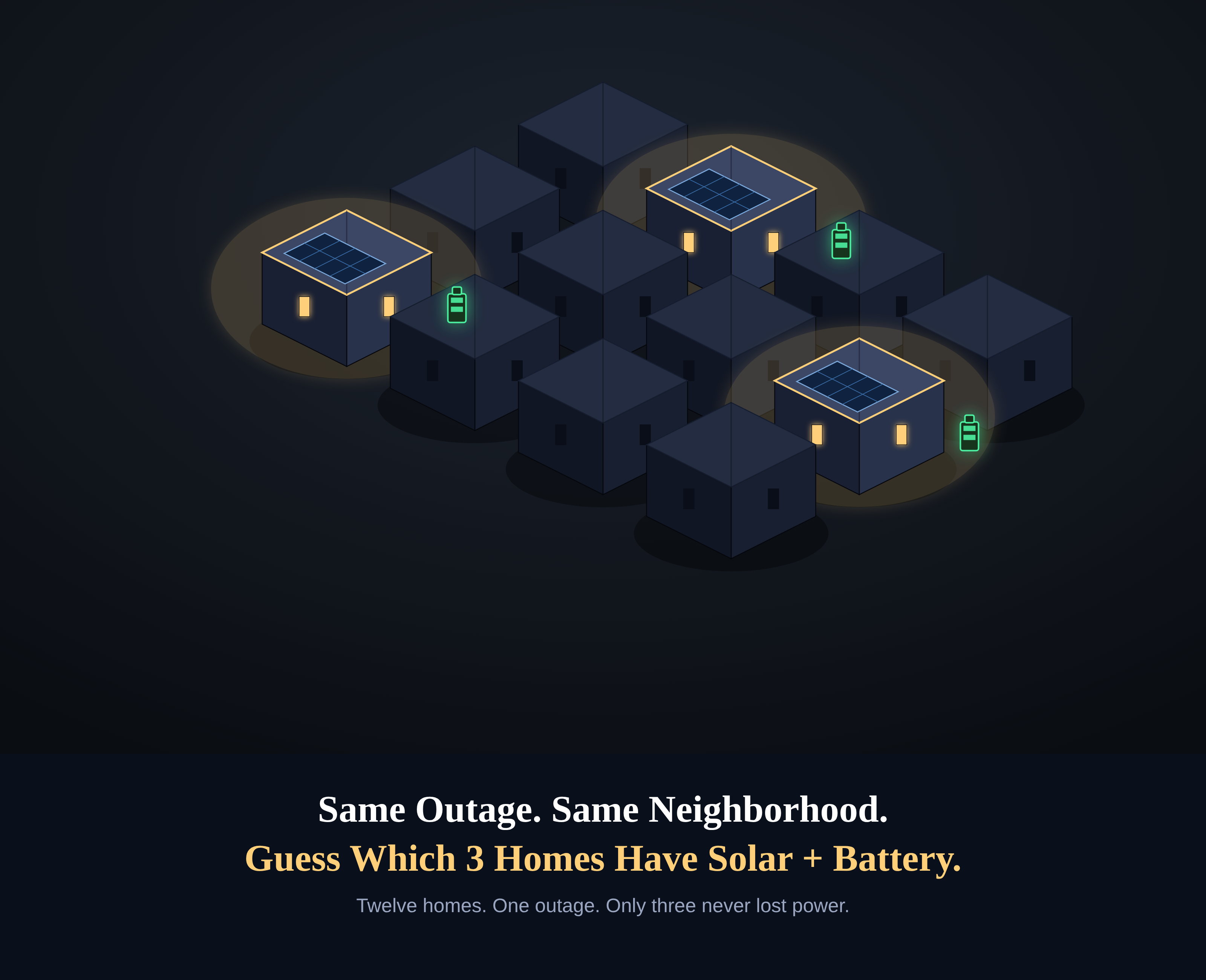
Every figure above is based on solar-only home sales: none of these studies isolated what a battery adds on top of that. Here's what a battery does in the real world: during an outage, homes with solar and battery backup keep the lights on while the rest of the neighborhood goes dark. That's a real, tangible benefit a buyer can see for themselves, and it isn't priced into any of the resale premiums cited above. These figures are the floor. Nobody's published what the ceiling looks like yet with a battery included.
One more thing worth knowing about the federal tax credit
These studies were conducted while solar buyers still qualified for a federal tax credit under Section 25D. That credit ended for systems placed in service after December 31, 2025 (the One Big Beautiful Bill Act, signed July 2025) — so a new owned system today costs more out-of-pocket up front than it did for the homeowners these studies measured. That doesn't erase the resale premium itself; buyers still pay more for a home with solar already on it, credit or no credit. It just means today's net math looks a little different than it did for the original study participants.
If you go the leased/PPA route instead, this shift doesn't hit you directly — the solar company can still claim a separate commercial credit (IRC §48E) and typically prices that into your rate.
Owned vs. Leased Solar — The Honest Pros and Cons at Sale Time
Both are common, legitimate ways to go solar. Here's what's actually true about each — the good and the tradeoffs — so you can judge for yourself instead of taking our word for it.
ProTransfers automatically with the deed — nothing to apply for.
ConIf there's still a loan balance, it typically gets paid off out of your sale proceeds, like any other loan tied to the home.
ProThe lease can transfer directly to the buyer — you're not required to buy it out.
ConThe buyer has to pass the solar company's credit approval first, which adds a step (and a small chance they aren't approved).
ProDocumented resale premium (Zillow Research, Lawrence Berkeley National Laboratory) since appraisers count real property you own.
ConNot guaranteed on every home, and it applies differently for systems bought after the federal owner tax credit ended in 2025 (higher upfront cost for today's buyers).
ProEven without a formal appraisal bump, a home with a low, already-locked-in energy cost is still a real selling point to an informed buyer.
ConAppraisers value property you own, not a third-party contract, so it usually doesn't show up as a formal value increase.
ProNo ongoing third-party payment once any loan is paid off — the buyer's savings are effectively guaranteed.
ConThe manufacturer's equipment warranty has to formally transfer too — usually straightforward, but it's an extra step buyers sometimes ask about.
ProBuyer typically steps into a rate that's often lower than the utility rate, with nothing paid upfront for the system.
ConNot guaranteed — depends on the specific lease rate versus the utility rate at the time of sale.
ProA loan payment (if any) is fixed, and a paid-off system has no ongoing payment at all.
ConMaintenance and repairs are the owner's responsibility, not a third party's.
ProMaintenance and repairs are typically the solar company's responsibility, not yours.
ConMany contracts include a payment escalator (commonly 1–3%/year) — common, but not universal, so it depends on the specific contract.
ProIf you bought before the credit ended, that value is already baked into your home's equity.
ConSection 25D ended for systems placed in service after 12/31/2025 — buying today, you no longer get this at the personal level.
ProThe solar company can still claim a separate commercial credit (IRC §48E) and typically prices that into your rate.
ConHow much actually gets passed through to you isn't standardized or itemized the way the old owner credit was — it varies by provider.
Why the Bay Area Premium Is Even Higher
PG&E's E1 rate plan — the default residential tariff since 2014, and still the plan most long-time solar customers are on — has risen roughly 150% since 2014 (see the actual PG&E history in the rate-projection tool above). That's an average of about 8–9% a year, and our own projections assume that trend continues at 8% annually going forward.
That matters more here than in most places. Summer cooling loads and time-of-use peak pricing hit Bay Area homes in Dublin, Pleasanton, San Ramon, and Livermore especially hard, and rates aren't projected to level off. Solar has gone from a nice-to-have to a standard line item on buyer checklists — and it's increasingly the homes without it that buyers ask questions about.
How Appraisers Value Solar
Appraisers use three standard approaches, and which one applies depends on whether your system is owned or leased.
Sales Comparison Approach
The preferred method under lending guidelines. Appraisers compare your home against similar homes with owned solar systems that have sold nearby. The tradeoff: solar comps can be scarce in some markets.
Cost Approach
Values the system on a cost-per-watt basis, adjusted for depreciation as equipment ages and panel prices decline over time.
Income Approach
Estimates value based on the energy savings a buyer can expect, discounted to today's dollars over the system's remaining useful life.
Many appraisers use PV Value®, a free tool that applies the income and cost approaches to generate a documented estimate for the appraisal report.
One important limit: Fannie Mae, Freddie Mac, FHA, and VA guidelines all exclude leased systems and PPAs from the appraised value, even though appraisers are required to note them in the report. This is the same distinction covered in the pro/con breakdown above — owned systems can add documented value; leased systems typically don't, even though they still deliver real savings to the buyer.
What Can Lower an Owned System's Appraised Value
Aging equipment (typically 10+ years old), panels from manufacturers no longer in business, and a lack of production monitoring data to document actual performance can all result in a lower appraisal than a newer, well-documented system.
NEM 2.0 vs. NEM 3.0: What Buyers Need to Know
Homes with solar installed before April 2023 are likely grandfathered into NEM 2.0, which offers significantly better export credits than the current NEM 3.0 (Net Billing Tariff). This grandfathered status transfers with the home and is a genuine financial asset.
A NEM 2.0 system can be worth thousands of dollars more per year in bill savings than an equivalent NEM 3.0 system. Savvy buyers — and their agents — are starting to ask about this specifically.
If you're selling a home with a NEM 2.0 system, make sure your listing agent highlights this. If you're buying, ask whether the system is on NEM 2.0 or NEM 3.0 — it materially affects the value of what you're purchasing.
Maximizing Your Solar Home's Value at Sale
Get a solar-specific appraisal
Request that your appraiser use the PV Value® tool, the industry standard for solar valuation. Not all appraisers are trained on solar — ask specifically.
Document everything
Compile your system specs, installation date, warranty documents, production history, and utility interconnection agreement. Buyers and their lenders will ask for these.
Know your NEM status
Confirm whether you're on NEM 2.0 or NEM 3.0 and include this in your listing. NEM 2.0 grandfathering is a selling point worth calling out explicitly.
Highlight actual production data
Show buyers 12 months of production data and the corresponding utility bills. Real numbers are more persuasive than estimates.
Work with a solar-literate agent
Not every real estate agent knows how to position solar as an asset. Find one who does — or make sure your agent consults with a solar professional before listing.
Thinking About Solar Before You Sell — or Buy?
Whether you're planning to install solar before listing, trying to understand the value of an existing system, or evaluating a home purchase, Solar Bill Review can help you run the numbers.